|
Travel Tale No. 2, Vol. 3 - India - Nice
to Visit, Nicer to Leave
 In
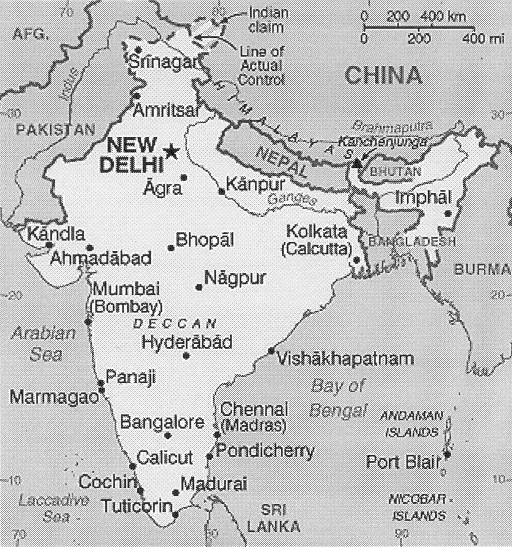
my book, MURDER BY ROSES, I talk a little about India and Sri Lanka. During my
visit to Agra, India, I posed like every tourist does in front of the fabulous
Taj Mahal. (Here I am with my brother below.) This beautiful white marble
mausoleum was built by the Mughal emperor Shah Jahan who was heartbroken when
his second wife, Mumtaz Mahal, died in childbirth in 1631. After construction
was completed by 20,000 men in 1653, as legend goes, the hands of the best
workers were cut off so they never could build a more beautiful building. I
found this type of cruelty commonplace all around India. Over two million
tourists visit this famous monument every year, and I think they were all
there that day as we were practically attacked by the residents of Agra
pushing and shoving postcards of the Taj in our faces. In
my book, MURDER BY ROSES, I talk a little about India and Sri Lanka. During my
visit to Agra, India, I posed like every tourist does in front of the fabulous
Taj Mahal. (Here I am with my brother below.) This beautiful white marble
mausoleum was built by the Mughal emperor Shah Jahan who was heartbroken when
his second wife, Mumtaz Mahal, died in childbirth in 1631. After construction
was completed by 20,000 men in 1653, as legend goes, the hands of the best
workers were cut off so they never could build a more beautiful building. I
found this type of cruelty commonplace all around India. Over two million
tourists visit this famous monument every year, and I think they were all
there that day as we were practically attacked by the residents of Agra
pushing and shoving postcards of the Taj in our faces.
 From
there we traveled by car 210 miles to New Delhi. I thought we would never get
there that sweltering, fly-infested day, after our taxi driver stopped for
thirty minutes not wanting to disturb a white cow blocking the road. No amount
of cajoling would get him to proceed, as a Hindu cow worshipper he did not
want to offend the animal, honoring its decision to sit in the middle of the
road as we melted in the car. Finally, I got out, picked up a stick and
prodded the cow to move out of the way, much to the horror of the driver who
was yelling at me in Hindustani, something about a woman not interfering with
cow dominance! My stepfather told him to move over that he would drive the car
right into the cow's rear if it didn't move fast as we were melting without
air-conditioning and the flies were driving us crazy. By then about thirty
laughing children had circled our car and would not let us continue unless we
threw money out the window. We did, and continued to Delhi where we checked
into a converted palace hotel. The rooms were enormous, decorated in peacock
blues and greens, and had the original "air-conditioning" water ways of white
marble in the floors, fanned by huge straw fans to cool the place. I had to
look down so as not to trip in them, not expecting to find water in the floor. From
there we traveled by car 210 miles to New Delhi. I thought we would never get
there that sweltering, fly-infested day, after our taxi driver stopped for
thirty minutes not wanting to disturb a white cow blocking the road. No amount
of cajoling would get him to proceed, as a Hindu cow worshipper he did not
want to offend the animal, honoring its decision to sit in the middle of the
road as we melted in the car. Finally, I got out, picked up a stick and
prodded the cow to move out of the way, much to the horror of the driver who
was yelling at me in Hindustani, something about a woman not interfering with
cow dominance! My stepfather told him to move over that he would drive the car
right into the cow's rear if it didn't move fast as we were melting without
air-conditioning and the flies were driving us crazy. By then about thirty
laughing children had circled our car and would not let us continue unless we
threw money out the window. We did, and continued to Delhi where we checked
into a converted palace hotel. The rooms were enormous, decorated in peacock
blues and greens, and had the original "air-conditioning" water ways of white
marble in the floors, fanned by huge straw fans to cool the place. I had to
look down so as not to trip in them, not expecting to find water in the floor.
 The next day
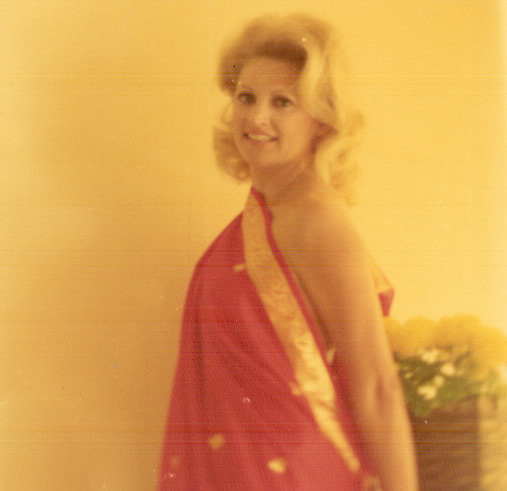
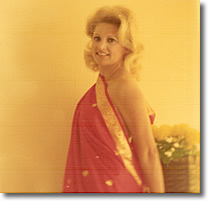
we walked over to the market place to buy some souvenirs. I bought this red
silk sari I am wearing in the photo. My brother bought a musical instrument
that resembled a pregnant cello, (I wonder if he ever learned to play that
ridiculous instrument since he played trombone in high school.) Dad bought Mom
some loose gems of sapphires, rubies, and topaz. The next day
we walked over to the market place to buy some souvenirs. I bought this red
silk sari I am wearing in the photo. My brother bought a musical instrument
that resembled a pregnant cello, (I wonder if he ever learned to play that
ridiculous instrument since he played trombone in high school.) Dad bought Mom
some loose gems of sapphires, rubies, and topaz.
As we wandered around the streets we were accosted by crippled children
beggars. We were told that some of the mothers purposely break the bones of
their babies to convert them into beggars. We had to start throwing coins in
the air to get them to leave us alone since they pulled on our clothes. A
rather pathetic sight, but when you consider their population explosion of one
billion, ninety-five million, three hundred fifty-one thousand and nine
hundred ninety-five (1,095,351,995) people, their desperation comes as no
surprise.
 In
Jaipur, I got motion sick riding the proverbial elephant as the basket
oscillated from left to right. I always get motion sick on buses, boats, and
elephants, but it has never stopped me from traveling. This trip was very
enlightening and educational. It proved to me what happens when birth control
is not practiced and then and there I became pro choice. In
Jaipur, I got motion sick riding the proverbial elephant as the basket
oscillated from left to right. I always get motion sick on buses, boats, and
elephants, but it has never stopped me from traveling. This trip was very
enlightening and educational. It proved to me what happens when birth control
is not practiced and then and there I became pro choice.
India's diverse economy encompasses traditional village farming, handicrafts,
embroidery, and a multitude of services. Government controls on foreign trade
and investment have been reduced in some areas, but high tariffs and limits on
foreign direct investment are still in place. Despite strong growth, the World
Bank worries about the combined state and federal budget deficit. English is
the most important commercial communication, but there are 14 other official
languages: Bengali, Telugu, Marathi, Tamil, Urdu, Gujarati, Malayalam,
Kannada, Oriya, Punjabi, Assamese, Kashmiri, Sindhi, and Sanskrit. Hindustani
is a popular variant of Hindi/Urdu, spoken throughout northern India.
In December 2004, a tsunami killed about 60,000 people and severely affected
their fishing fleet. India can be hauntingly mysterious and certainly has many
wonderful natural resources, like tea, as the Brits found out, but I did not
enjoy seeing the cobras dancing out of their baskets to the flute music as I
walked in the streets full of crippled children, beggars, flies, and monkeys
screeching.
Currently it is a destination and transit area for men, women and children
trafficked for forced labor and commercial sexual exploitation. Millions of
them are in debt bondage in rice mills, factories, while children endure
involuntary servitude as domestic servants, and young girls are forced into
sexual exploitation.
It is the world's largest producer of licit opium for pharmaceutical trade,
but a certain amount of opium is diverted to illicit international drug
markets, with money laundering through the hawala system.
Their chief of state is President A.P.J. Abdul Kalam, with their next election
to be held in July 2007.
Quite honestly, I couldn't wait to leave. So the next time I see someone
burning the American flag I will personally give them a one-way ticket to
India, to see if they are happier there! Or, they can email me, and I will
tell them some more horror stories of how the rest of the world I visited
lives.
Alinka Zyrmont
|